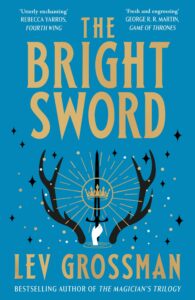
Callum is a gifted young knight from a remote part of the British Isles. After a childhood of neglect and abuse, he discovers his natural aptitude for violence. Rather than rebelling against his cruel, provincial master, Callum sets himself a higher purpose. He wants to become a knight, and to serve alongside the greatest in the land. Stealing a sword and armor, he sneaks away. Convinced of his purpose, Callum crosses the full length of the land, drawn to the shining heart of civilisation, to swear fealty to King Arthur and the Knights of the Round Table.
Except… they aren’t there.
Arthur is dead. The King has fallen. Camelot is empty and the Knights of the Round Table have all been slain or scattered to the winds. Merlin has been betrayed by his apprentice, Nimue, and sealed away beneath the earth. There is no King; there are no knights. There is, quite probably, no longer even a country.
In the echoing corridors of Camelot, Callum finds only (pardon the pun) table scraps. There are a a handful of knights that, for some reason or another, missed out on Camlann, the climactic final battle of Arthur’s reign. Left to their own devices, the knights grieve, fret, and eventually fall to plotting. Arthur’s grand vision has been left to them, and unless they can somehow hold together the crumbling peace, the King’s sacrifice will be for nought.
The Bright Sword takes place in the shadow of myth. Our heroes—and they are truly heroes—work in full awareness of their own inferiority. They, themselves, have lived and served alongside legends: Arthur, Lancelot, Galahad. Our knights can only see themselves as what they are not; rating themselves by their failures. But they are all that remain, and so, without those gifts or divine privileges, the burden is theirs. What Arthur did was impossible and incredible, and now, it falls to them to preserve it.
The knights’ quest is punctuated by flashbacks, as we learn their origins. They each – despite being the ‘dregs’ of the table – are absolutely incredible: triumphs of spirit and will against incredible adversity. It is because of their struggles that they are heroes: they have accomplished more, despite all the challenges arrayed against them. Each in turn is a powerful, compelling character, brought to life by Grossman in a way that gives each knight and their story a unique voice, without ever being patronising tokenistic.
I’m being deliberately light-touch with the detail here. The Bright Sword has big cosmic-level fights, a big ol’ battle, and some duels that made me want to cheer out loud. It also has one heart-warming romance and a few tragic ones. There’s plenty of banter and a light dusting of snark. History happens. The villains (the real villains) are as horrifying as the heroes are inspiring. Perhaps even more so, given their plausibility. The ending is deeply satisfying and thematically perfect. It is, without even getting into everything else, a genuinely great epic fantasy story.
But it is, like all great fantasy, much more than that.
I am a sucker for an Arthurian retelling: I think it is a platform for great stories about tragedy, romance, virtue, questing, brotherhood, chivalry, etc. The knight errant structure also lends itself to ‘monster of the week’ episodes: Arthurian legend is just as good at little stories as it is big, sweeping narratives.
A few years ago, while reviewing Sword Stone Table, it struck me, for example, that although all the stories were about Arthurian characters, none of them were about Britain. Sword Stone Table had the deliberate editorial mission set out to tell inclusive stories, and it achieved that end brilliantly. It showed how the ‘core’ myth is a story that is still relevant to a huge variety of lived experiences. Along the way, the anthology also served as (yet another) demonstration of how making room for marginalised voices can bring fresh, exciting stories to the proverbial table. I’m also a long-standing fan of Maurice Broaddus’ The Knights of Breton Court (recently, finally, re-issued), which sets Arthur in—of all places—urban Indianapolis. Billed as Arthur x The Wire, it is a pulpy, punchy and raw interpretation of the source material. A good myth—a great myth—has that kind of flexibility while still maintaining a close relationship with its core themes.
Diverse, inclusive reinterpretions of Arthur all demonstrate that there are still something new and interesting meanings to be prised out of a story over a thousand years old. It should be remixed and retold often as it is reread. The myth of ‘Arthur’ has unquestionably become more and more delocalised as time has gone by. We’ve seen Arthur in every possible point of the space-time continuum: Indianapolis, coffee shops and beyond. However,… there is also still space for Arthurian stories about its original place and time. Arthurian myth is demonstrable, universally, brilliantly relevant to many, but it also has a unique significance to Britain.
Arthur is, I would argue, the closest thing that we have to a national myth (I would also accept Robin Hood). It is an ‘origin’ story for Britain, one that even speaks—if ahistorically—to the notion of a united kingdom. The Arthurian cycle also demonstrates and embeds a set of values: chivalry, but also curiosity; certainty, but also an acceptance of human frailty. You can spin a golden thread from the worldview espoused in Arthurian myth through all the best (and arguably worst) of British history. An open-sourced Arthur is important, and the decolonisation of these stories is both karmic and just. However, in a 21st century Britain that is presently and actively wrestling with the problems that Arthur faced—a quest for unity, clear identity and shared values—it is clear that these stories still have a role to play back home.
In The Bright Sword, Grossman brings Arthur back to Britain. Grossman is, of course, not British – but then, neither was Geoffrey of Monmouth. His commitment to research and perspective both shows through. The man and the myth are reconnected with this specific land, culture, history and people. Grossman’s story follows in the tradition of Mary Stewart by showing how critically important these legends are to the here and now. Arthur, Grossman shows, is more than a man, or even a king. He’s an aspiration and an ideal. He’s somehow both inspirational and flawed, more than mortal but less than perfect. Larger and bolder than being another story about the King himself, The Bright Sword updates our national narrative to add new dimensions of inclusivity; to make righteousness something less static and more progressive. It updates Arthurian ideals as a way of being and behaving that is no longer rigid or inflexible. The aspiration of Camelot is shifted from a place to an idea; a moment to a continuum. The Bright Sword belief that—whatever the odds—good is possible, and we can all help achieve it.
Thank you to Jared Shurin for contributing this guest review to the Fantasy Inn!